
Hydraulic Breaker Buying Guide: A Contractor's Guide to Choosing the Right Hydraulic Breaker
Posted on: July 7, 2026
Hydraulic breakers have become one of the most valuable attachments in construction, demolition, excavation, utility installation, quarrying, and municipal maintenance. From removing reinforced concrete and breaking rock to trenching utilities and preparing building sites, the right breaker can transform a carrier machine into a highly productive demolition tool.
Recognizing these challenges, Blue Diamond® spent more than five years researching hydraulic breaker technology before introducing its breaker lineup. Rather than simply designing another demolition hammer, engineers focused on solving the maintenance and reliability issues contractors experience every day.
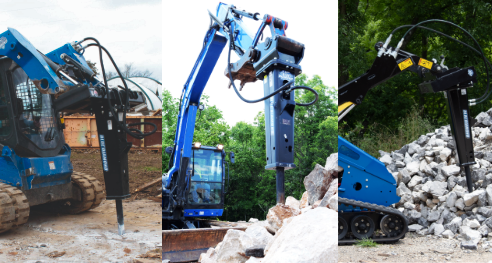
The result is a family of hydraulic breakers built around advanced engineering, simplified maintenance, and exceptional durability. Whether mounted on a mini skid steer, skid steer, compact track loader, or excavator, every Blue Diamond Hydraulic Breaker is designed to maximize uptime while reducing operating costs.
Designing a Better Hydraulic Breaker
Blue Diamond approached hydraulic breaker development differently than many manufacturers. Instead of focusing solely on striking force, engineers identified the most common complaints from contractors and rental companies before designing the product.
Every engineering decision was made with one objective: help contractors spend more time breaking concrete and less time maintaining equipment.
Development goals included:
- Eliminating maintenance associated with tie-rod breaker designs
- Simplifying installation on multiple host machines
- Reducing service and maintenance time
- Increasing structural durability
- Improving hydraulic efficiency
- Protecting expensive internal components
- Reducing back-pressure concerns
- Lowering total cost of ownership
Mono-Block Construction: A Better Foundation
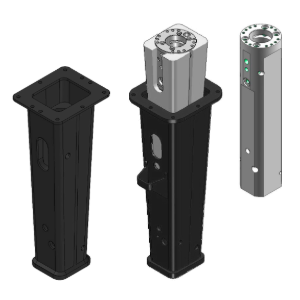
One of the defining characteristics of every Blue Diamond Hydraulic Breaker is its solid mono-block housing. Many competitive breakers are assembled using multiple housing sections held together by long tie rods. Over time, repeated impact loads can stretch or loosen these rods, requiring maintenance and increasing the possibility of expensive failures. Blue Diamond eliminates these concerns by machining the breaker body from a single piece of steel.
This mono-block design provides:
- Greater structural strength
- Increased rigidity
- Fewer maintenance requirements
- Longer service life
- Improved reliability under heavy workloads
Simplicity Equals Reliability
Complex equipment often creates additional opportunities for failure.
Blue Diamond Hydraulic Breakers utilize only two internal moving components—the piston and the distributor valve. This simple design reduces wear points, simplifies troubleshooting, and makes servicing faster compared to more complicated breaker designs. For contractors, municipalities, and rental fleets, fewer moving parts often translate directly into greater uptime and lower maintenance expenses.
Energy Recovery System
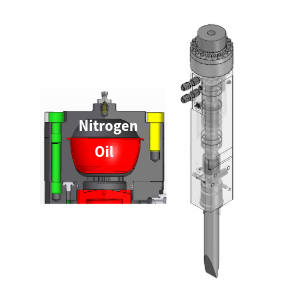
Every hydraulic strike creates hydraulic pressure that many competitive breakers simply waste. Blue Diamond's energy recovery system recycles that pressure back into the striking cycle resulting in lower RPM requirements and less fuel consumption.
- Accumulator is set on top of monoblock.
- Functions by transmitting stroke power energy to piston
- Cover is connected to base by short bolts (yellow)
- Assembly is connected to monoblock by long bolts (green)
- Service breaker by removing long bolts - no need to recharge with nitrogen
- Upper part separated by rubber or polyurethane diaphragm
This allows contractors to complete demolition work more efficiently without increasing the hydraulic requirements of the carrier.
No Nitrogen Re-Gassing
Many hydraulic breakers require periodic nitrogen charging to maintain proper performance. Blue Diamond eliminates this maintenance requirement.
Without nitrogen charging, operators benefit from:
- Less routine maintenance
- Reduced service costs
- Less downtime
- More consistent performance
This is especially valuable for rental fleets and contractors who need equipment ready to work every day.
Anti-Blank Firing Protection
Dry firing is one of the fastest ways to shorten breaker life.
Blue Diamond's integrated anti-blank firing system prevents the piston from cycling until the tool is firmly against the work surface, reducing pressure spikes and protecting internal components.
Benefits:
- Prevents internal damage
- Reduces downtime and repair costs
- Extends breaker and tool life
- Improves overall reliability and operating efficiency
Polyurethane Vibration Isolation
Hydraulic breakers generate tremendous vibration. Blue Diamond surrounds every breaker with a polyurethane vibration-dampening shell that absorbs shock before it reaches the carrier.
Benefits include:
- Improved operator comfort
- Reduced vibration transfer
- Longer hydraulic component life
- Reduced wear on pins and bushings
- Better protection for the excavator or skid steer
Reducing vibration not only protects the breaker—it also helps extend the life of the machine carrying it.
Faster Service Means More Productivity
Downtime costs money. Blue Diamond breakers were engineered to simplify maintenance whenever service becomes necessary.
The accumulator can be removed as a complete assembly, minimizing disturbance to the hydraulic system. Combined with the simple two-part internal design, many rebuilds can be completed significantly faster than traditional breaker designs.
Choosing the Right Hydraulic Breaker
Selecting the correct breaker is about matching the attachment to both the carrier and the application. Choosing a breaker that is too small can reduce productivity, while selecting one that is too large may reduce machine efficiency and stability.
Three factors should always be considered.
1 - Carrier Weight
Every breaker is designed for a specific carrier weight range.
Proper matching improves:
- Stability
- Impact efficiency
- Machine longevity
- Overall productivity
Blue Diamond offers breaker models for carriers ranging from compact mini machines to excavators exceeding 100,000 pounds.
2 - Hydraulic Flow
Matching hydraulic flow is equally important. Blue Diamond offers multiple breaker sizes designed to accommodate both standard-flow and higher-flow hydraulic systems.
Proper hydraulic matching helps maximize:
- Impact energy
- Tool life
- Hydraulic efficiency
- Fuel economy
3 - Application
Different jobs require different breaker sizes.
Typical applications include:
Mini Skid Steers
Compact demolition, residential concrete removal, fence posts, sidewalks, landscaping, utility trenching, and interior renovations.
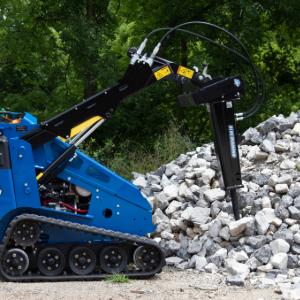
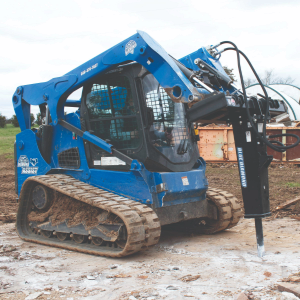
Skid Steers & Compact Track Loaders
Commercial demolition, road repair, parking lots, foundations, utility work, asphalt removal, and rock excavation.
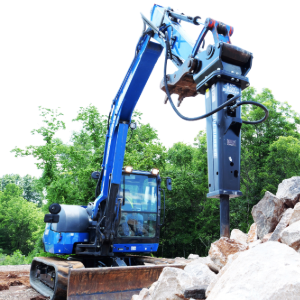
Excavators
Bridge demolition, quarry operations, foundation removal, mining support, pipeline construction, highway projects, large-scale concrete demolition, and heavy rock excavation.
Why Total Cost of Ownership Matters
The purchase price of a hydraulic breaker is only part of the equation.
Long-term profitability depends on:
- Reliability
- Maintenance
- Downtime
- Fuel efficiency
- Service costs
- Machine wear
Blue Diamond's mono-block construction, replaceable wear sleeves, vibration isolation, anti-blank firing protection, energy recovery system, and simplified hydraulic design all contribute to reducing ownership costs over the life of the attachment.
Rather than simply selling impact energy, Blue Diamond engineers focused on building a breaker that delivers maximum return on investment for contractors, municipalities, utility crews, and rental fleets.
Frequently Asked Questions
What makes a mono-block hydraulic breaker better?
Mono-block construction eliminates tie rods, providing greater structural strength, improved durability, and fewer maintenance requirements.
Do Blue Diamond breakers require nitrogen charging?
No. Blue Diamond Hydraulic Breakers require no nitrogen re-gassing, simplifying maintenance and reducing downtime.
Why is anti-blank firing important?
It prevents unnecessary impacts when the tool isn't against the material, helping extend the life of the piston and internal components.
Are Blue Diamond breakers available for different machine types?
Yes. Blue Diamond offers hydraulic breakers for mini skid steers, skid steers, compact track loaders, and mini and full-size excavators, with mounting options available for most major equipment manufacturers.
What industries commonly use hydraulic breakers?
Construction, demolition, road building, utilities, municipalities, quarrying, mining, agriculture, landscaping, and infrastructure development all rely on hydraulic breakers to improve productivity.
Built to Break More. Engineered to Last Longer.
Every Blue Diamond Hydraulic Breaker is designed around one goal: delivering dependable breaking performance while minimizing downtime and ownership costs.
From the solid mono-block housing and energy recovery system to vibration isolation, anti-blank firing protection, and simplified maintenance, every feature is engineered to help contractors complete more work with greater confidence.
Whether you're removing sidewalks with a mini skid steer, breaking foundations with a skid steer, or tackling large-scale rock excavation with a full-size excavator, Blue Diamond offers a hydraulic breaker engineered to maximize productivity, reliability, and return on investment.
Explore the complete lineup of Mini Skid Steer Hydraulic Breakers, Skid Steer Hydraulic Breakers, and Excavator Hydraulic Breakers to find the model that's right for your machine and your next project.